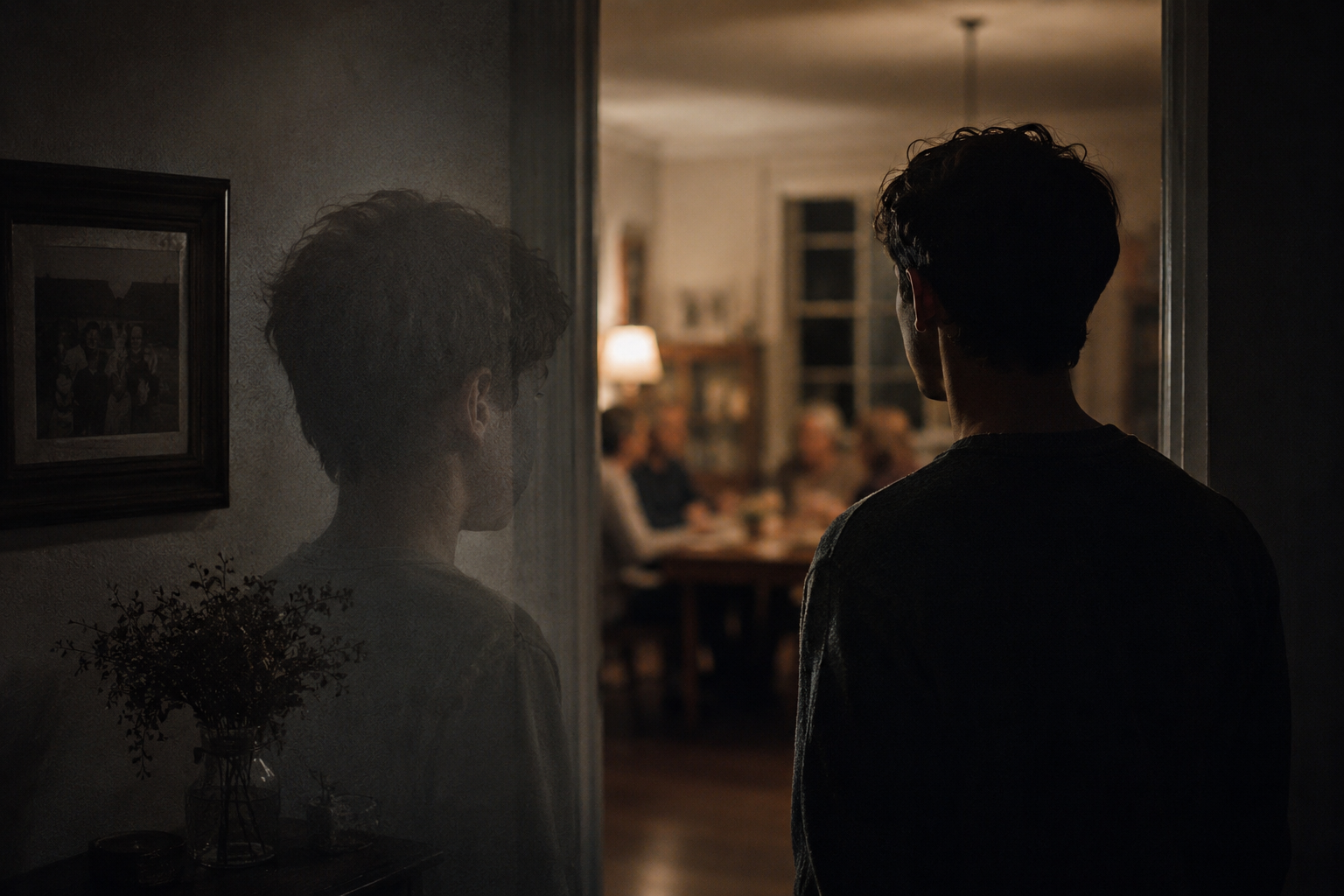
One of the stranger aspects of personal growth is discovering that healing can feel incredibly real—until you are around certain people.
You may spend years doing the inner work—learning your patterns, strengthening boundaries, becoming more emotionally aware, and consciously choosing healthier ways of relating. Over time, the changes feel genuine. You communicate differently. You react less impulsively. You recognise unhealthy dynamics more quickly. You feel calmer, clearer, and more grounded in who you are...or so you thought.
Then you spend time with family, or reconnect with an old friend, and something shifts.
Not always dramatically, and not always in ways others would notice, but internally something familiar begins to stir. You may find yourself over-explaining, softening your opinions, seeking approval you thought you no longer needed, or becoming unusually defensive, quieter, or subtly accommodating in ways that feel strangely unlike the person you have become. The immediate thought is often unsettling: I thought I had already worked through this. And that is just the thoughts, the body is already way ahead of the curve.
But this experience is far more psychologically coherent than many people realise.
The brain is not simply responding to what is happening in the present moment. Much of the time, it is anticipating what might happen based on what it has experienced before. It is a predictive organ, a supercomputer constantly scanning for familiarity and comparing present cues to previously significant emotional experiences. Its primary role is not personal growth or emotional liberation. Its base role is survival and survival alone. YOU teach it when it is safe.
This becomes particularly relevant in relationships, especially formative ones. Long before we had the language to understand emotional complexity, our nervous systems were already learning the rules of belonging.
What secured connection.
What created distance.
Whether emotional honesty was safe.
Whether our needs were welcome.
Whether being visible brought comfort or criticism.
These lessons do not simply remain as memories we can consciously recall. They become embedded in the body as expectations.
This is why certain people can evoke responses that feel immediate and disproportionate. A familiar tone of voice, a subtle expression, the emotional atmosphere of a family gathering, or even the anticipatory tension of walking into a familiar home can activate old neural pathways with surprising speed. The nervous system often recognises familiar conditions before the conscious mind has fully interpreted what is happening.
Psychology would describe this as activation rather than regression, and that distinction matters. Regression suggests that progress has somehow been lost, that healing was temporary or performative. Activation tells a different story. It suggests that an older protective response has been triggered because the nervous system has recognised a familiar emotional environment and reached for strategies that once helped preserve safety, belonging, or emotional equilibrium.
That does not mean the healing was false. It means older wiring still exists. It suggests that raiding your parents fridge when you get to their home, or falling asleep on the couch as the norm...therefore destined to repeat the same behaviour once entering the family home once more.
Growth is not simply the acquisition of insight. Insight can be transformative, but awareness alone does not automatically rewire deeply conditioned responses, sorry. The brain strengthens pathways through repetition, particularly repetition under emotionally charged conditions. This is why personal growth can feel stable in everyday life, yet unexpectedly fragile in the very environments where earlier versions of the self were originally shaped.
Family systems make this even more complex. Most relational systems unconsciously organise themselves around predictable roles. The caretaker. The peacekeeper. The achiever. The emotionally capable one. The difficult one. The one who becomes small to avoid conflict. These roles often begin as adaptive responses, especially in childhood, but over time they become so familiar that they feel like identity.
When one person changes, the system notices.
Not always consciously. Not always maliciously. But systems are built around familiarity, and familiarity creates a kind of emotional equilibrium, even when that equilibrium is unhealthy. If the person who once avoided conflict begins speaking honestly, tension rises. If the caretaker starts setting boundaries, others may interpret it as rejection. If the one who always sought approval becomes self-assured, the dynamic shifts in ways that can feel uncomfortable for everyone involved.
Part of what makes these moments so confronting is that not everything being activated comes from the external environment alone. Read that again.
This is where shadow work becomes deeply relevant.
Because personal growth does not erase the parts of us that once adapted for survival. The people-pleaser does not disappear simply because we now understand why they emerged. The hyper-vigilant protector does not dissolve because we intellectually recognise their purpose. The child who learned that harmony was safer than honesty, or the version of self that became highly competent because vulnerability once felt dangerous, may still exist beneath conscious awareness.
Old relationships do not necessarily recreate these parts. Often, they simply summon them.
Shadow work invites us to approach these moments differently. Rather than seeing the resurfacing of old patterns as failure, we can begin asking more honest questions. Which part of me has become active here? What is it trying to protect? What emotional outcome does it still expect? What old contract is it unconsciously trying to uphold?
This is where soul work, in a grounded sense, also has something to offer.
Not as an escape from psychology, but as a deeper companion to it.
The soul is not the part of us that never gets triggered, never reacts, or exists beyond human complexity. Perhaps the soul is better understood as the witnessing presence within us - the quieter, deeper awareness capable of observing these activated parts without collapsing into them. The work is not to reject old selves or exile wounded adaptations. It is to meet them consciously, with enough compassion and clarity that they no longer govern us without awareness.
Perhaps this is the real invitation in these moments.
Not shame.
Not self-judgment.
But curiosity.
What does this environment still teach my nervous system to expect? What part of me has stepped forward? Is this response still necessary, or merely familiar?
Healing may not be measured by never becoming activated again. It may be measured by how quickly awareness returns, how compassionately we meet what has surfaced, and whether we can consciously choose a different response while the older part of us is still asking to be protected.
I close this blog today with a word that you could research and get a better understanding of, that word is coherence.
Then ask yourself...am i truly in coherence with the growth part of myself. Do i truly with every cell in my body align with my growth?
Growth from Truth not from a Lie will always be more coherent.
much love and respect,
Elizabeth.